
Table
- What Is a Vertical Farm?
- The Rise of Vertical Farming Worldwide
- Core Technologies Behind Vertical Farming
- Benefits of a Vertical Farm
- Crops Best Suited for Vertical Farming
- Economic Considerations and Costs
- Sustainability and Environmental Impact
- Vertical Farming and Food Safety
- The Future of Vertical Farming
- Challenges and Limitations
- Conclusion
The global food system is undergoing a profound transformation. Population growth, climate change, land scarcity, and urbanization are pushing agriculture beyond traditional models. In this context, the vertical farm has emerged as one of the most innovative and promising solutions for producing food efficiently, locally, and sustainably.
What Is a Vertical Farm?
A vertical farm is an indoor agricultural system where crops are grown in vertically stacked layers, often using hydroponic, aeroponic, or aquaponic techniques. These farms typically operate in warehouses, shipping containers, or purpose-built facilities, enabling year-round production regardless of outdoor climate conditions.
By removing dependence on soil and weather, vertical farming allows producers to optimize growth cycles, reduce resource use, and locate food production closer to consumers.
How Vertical Farming Differs from Traditional Agriculture
- No soil dependency
- Minimal land footprint
- Controlled environment agriculture (CEA)
- Reduced water consumption
- Year-round harvesting
These differences fundamentally redefine how and where food can be grown, especially in urban environments.
The Rise of Vertical Farming Worldwide
Interest in vertical farming has accelerated rapidly over the last decade. According to research from FAO, urban populations are expected to account for nearly 70% of the global population by 2050. This shift increases pressure on food supply chains and highlights the need for localized production models.
A vertical farm addresses these challenges by reducing transportation distances, lowering food waste, and improving freshness. Major cities across North America, Europe, and Asia are investing heavily in indoor agriculture to strengthen food security.
Urban Agriculture and Food Resilience
Vertical farming enhances resilience by decentralizing food production. In times of supply chain disruption, local indoor farms can continue operating independently of external weather or geopolitical factors.
Core Technologies Behind Vertical Farming
Technology is the backbone of every successful vertical farm. Without precise control systems, indoor agriculture would not be economically viable at scale.
Lighting Systems
LED lighting tailored to plant photosynthesis is a defining feature of vertical farms. Modern LEDs provide specific light spectra that promote growth, flowering, and nutrient density while minimizing energy consumption.
Hydroponics, Aeroponics, and Aquaponics
- Hydroponics: Plants grow in nutrient-rich water solutions
- Aeroponics: Roots are misted with nutrients, maximizing oxygen exposure
- Aquaponics: Combines fish farming with plant cultivation in a closed-loop system
Each method offers unique advantages depending on crop type, scale, and operational goals.
Environmental Control Systems
Sensors and automation software regulate temperature, humidity, CO₂ levels, and airflow. These systems ensure consistent crop performance while reducing human error and labor costs.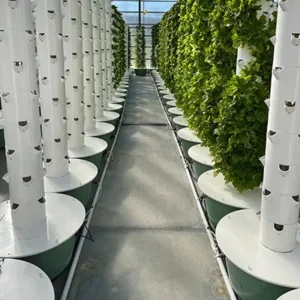
Benefits of a Vertical Farm
The appeal of vertical farming lies in its ability to produce more food with fewer resources. When managed correctly, a vertical farm delivers both environmental and economic advantages.
Resource Efficiency
- Up to 90% less water usage than field farming
- Minimal or zero pesticide application
- Reduced fertilizer runoff
Water recirculation systems drastically reduce waste, making vertical farming particularly valuable in water-scarce regions.
Consistent Quality and Yield
Because crops are grown under stable conditions, yield variability is significantly reduced. This consistency is highly attractive to retailers and food service providers seeking reliable supply.
Crops Best Suited for Vertical Farming
Not all crops are equally suited to indoor systems. Leafy greens and herbs dominate vertical farm production due to their fast growth cycles and high market value.
Common Crops
- Lettuce and spinach
- Basil, mint, and cilantro
- Microgreens
- Strawberries (in advanced systems)
Research from institutions such as NASA has contributed significantly to understanding plant growth in controlled environments, influencing modern vertical farming techniques.
Economic Considerations and Costs
While vertical farming offers impressive efficiencies, it also comes with high upfront costs. Facility construction, lighting systems, and automation require significant capital investment.
Key Cost Factors
- Energy consumption
- Infrastructure and equipment
- Skilled labor and technical expertise
- Maintenance and system upgrades
However, operational efficiency and premium product pricing can offset these costs over time, particularly in urban markets.
Scalability and Business Models
Successful vertical farms often adopt scalable models, expanding production incrementally while optimizing processes. Direct-to-consumer sales, restaurant partnerships, and subscription services are common revenue strategies.
Sustainability and Environmental Impact
A well-designed vertical farm aligns closely with sustainability goals. By eliminating agricultural runoff and reducing land conversion, indoor farming protects natural ecosystems.
According to the World Resources Institute, sustainable intensification of agriculture is critical to feeding future populations without further environmental degradation.
Energy Challenges
Energy use remains the largest environmental challenge for vertical farming. Integrating renewable energy sources and improving LED efficiency are key areas of ongoing innovation.
Vertical Farming and Food Safety
Indoor agriculture significantly reduces contamination risks. Controlled environments limit exposure to pathogens commonly associated with open-field farming.
As a result, produce from a vertical farm often meets higher food safety standards, requiring less washing and reducing post-harvest losses.
The Future of Vertical Farming
The future of vertical farming lies at the intersection of agriculture, technology, and urban planning. Advances in artificial intelligence, robotics, and plant genetics are expected to further improve efficiency and crop diversity.
As cities continue to grow, vertical farms may become integral components of urban infrastructure—embedded in residential buildings, supermarkets, and distribution hubs.
Challenges and Limitations
Despite its promise, vertical farming is not a universal solution. High energy requirements, limited crop variety, and economic barriers remain significant challenges.
Understanding these limitations is essential for realistic expectations and long-term success in the industry.
Conclusion
A vertical farm represents a powerful shift in how food can be produced in a rapidly changing world. By combining advanced technology with sustainable principles, vertical farming offers a viable path toward resilient, local, and efficient food systems.
For entrepreneurs, policymakers, and consumers alike, understanding vertical farming is no longer optional—it is a critical step toward shaping the future of agriculture.
How to Increase the Resilience of Agricultural Systems to Extreme Events
Integrated Pest Management with a Preventive, Not Reactive, Approach
Blockchain in Agriculture: Real Traceability and Adoption Challenges

When Was Vertical Farming Invented? A Complete History of Vertical Agriculture
Cannabis HVAC Design: How to Build Efficient and Compliant Grow Facilities

Aeroponic Farming Systems: High-Efficiency Soilless Agriculture
You might like...