

1. Introduction
Table
- 1. Introduction
- 2. Urban Food Security Challenges in the 21st Century
- 3. Traditional Farming Systems: Strengths and Limitations
- 4. The Rise of Vertical Farming
- 5. Comparative Analysis: Vertical vs. Traditional Farming
- 6. Case Studies of Urban Farming Success
- 7. Technology Driving Vertical Farming Efficiency
- 8. Economic, Environmental, and Social Impacts
- 9. Future Trends in Urban Agriculture
- Conclusion
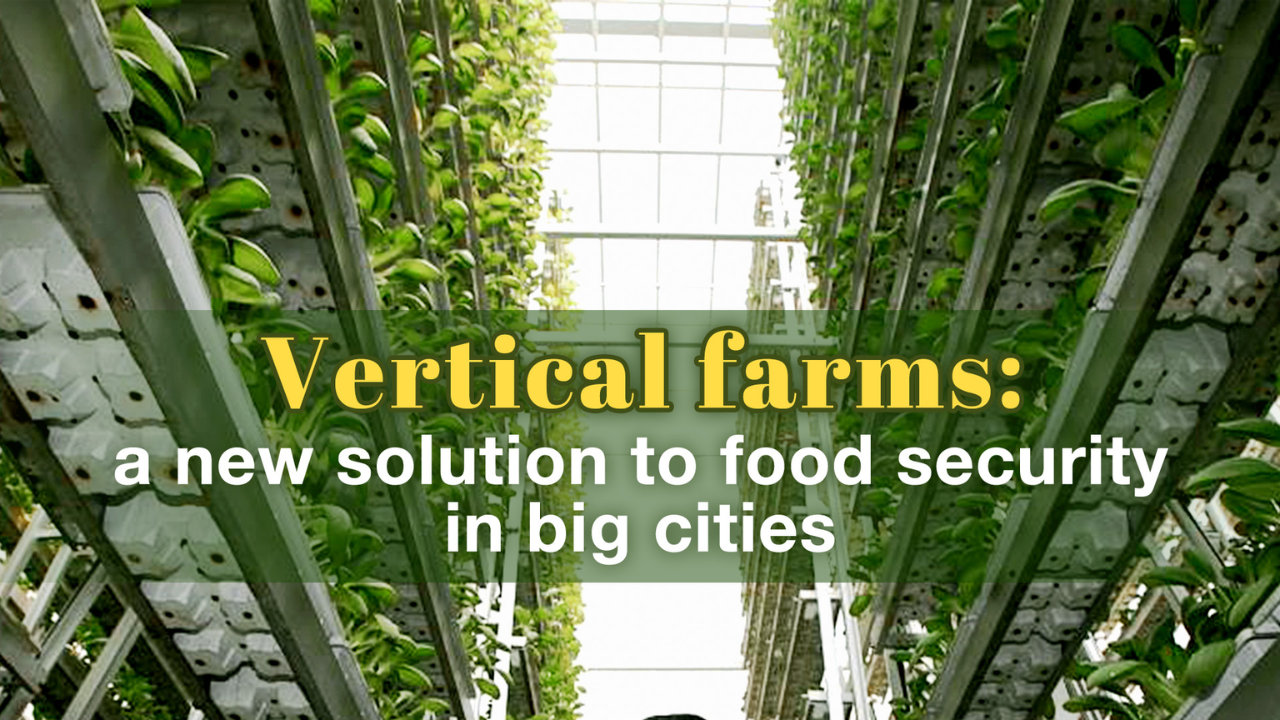
As global urbanization accelerates, ensuring food security within cities has become one of the greatest challenges of the 21st century. Traditional agriculture, which depends heavily on rural land, long transport routes, and favorable climate conditions, struggles to keep pace with rapid population growth and increasing food demand.
In contrast, vertical farming—a system that grows crops in stacked layers under controlled environments—has emerged as a promising alternative to bring fresh food directly to urban centers. This article, “Comparison Between Vertical and Traditional Farming to Ensure Urban Food Security”, explores how these two systems differ in terms of productivity, sustainability, and scalability, and evaluates their complementary roles in future urban food systems.
According to the United Nations Department of Economic and Social Affairs (UN DESA), by 2050, nearly 68% of the world’s population will live in urban areas—making localized, resource-efficient food production increasingly essential.
2. Urban Food Security Challenges in the 21st Century
Urbanization brings logistical, environmental, and social challenges to food security. As cities expand, arable land near urban areas decreases, transportation costs rise, and the environmental footprint of food systems grows. The COVID-19 pandemic and ongoing climate crises have highlighted vulnerabilities in global supply chains, emphasizing the need for more resilient local production systems.
Ensuring urban food security involves three key dimensions: availability (adequate food production), accessibility (affordable and equitable distribution), and sustainability (long-term environmental balance). Both traditional and vertical farming play critical roles in achieving these goals, though each with distinct advantages and constraints.
3. Traditional Farming Systems: Strengths and Limitations
Traditional farming remains the backbone of the global food system. It operates across vast landscapes, providing staple crops like wheat, maize, and rice. These systems rely on natural sunlight, soil-based cultivation, and seasonal cycles, which have sustained human populations for millennia.
Strengths
- High scalability for bulk production of staple crops.
- Rich biodiversity and ecosystem integration.
- Lower infrastructure costs compared to vertical farms.
- Established knowledge base and global market integration.
Limitations
- Dependence on weather and climate conditions.
- High water and land usage.
- Soil degradation and pollution from fertilizers and pesticides.
- Long supply chains increasing emissions and food loss.
According to the FAO’s State of Food and Agriculture Report, traditional agriculture accounts for 70% of freshwater use globally and contributes approximately 25% of total greenhouse gas emissions.
4. The Rise of Vertical Farming
Vertical farming represents a paradigm shift in food production. It involves growing crops in vertically stacked layers—often in warehouses, skyscrapers, or shipping containers—using artificial lighting, hydroponic or aeroponic systems, and controlled environmental conditions.
This method enables year-round production with minimal dependence on external weather, allowing fresh produce to be cultivated close to consumers. Vertical farms use significantly less water and land than traditional systems and can be powered by renewable energy sources.
Companies such as AeroFarms and Plenty have demonstrated that vertical farming can achieve yields up to 350 times higher per square meter than open-field agriculture, with up to 95% less water use.
5. Comparative Analysis: Vertical vs. Traditional Farming
When comparing vertical and traditional farming, several key factors define their effectiveness in ensuring urban food security:
5.1. Land Use Efficiency
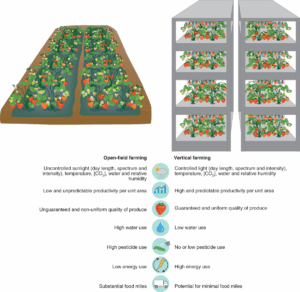
Vertical farms can be established within city limits, utilizing abandoned buildings or rooftops, while traditional farms require extensive rural land. This makes vertical farming ideal for dense urban areas with limited space.
5.2. Resource Consumption
Hydroponic systems in vertical farms use up to 90% less water, recycle nutrients, and minimize pesticide use. Traditional farms, however, depend on large water volumes and chemical inputs, leading to runoff and pollution.
5.3. Energy Requirements
Vertical farming relies heavily on artificial lighting and climate control, resulting in higher electricity costs. Traditional farms depend on sunlight but face variability due to weather and seasonal changes.
5.4. Yield and Productivity
Vertical farms achieve higher yields per square meter due to multi-level cultivation and precise control over growing conditions. However, traditional farms are better suited for large-scale staple crop production, such as grains and oilseeds.
5.5. Food Miles and Freshness
Because vertical farms are located near or within cities, food can reach consumers faster and fresher. Traditional farming relies on transportation networks, increasing food miles and carbon footprint.
5.6. Sustainability and Carbon Emissions
While vertical farming reduces land degradation and emissions from transport, its energy consumption remains a concern. Integrating renewable energy sources such as solar or wind power can significantly offset these emissions.
6. Case Studies of Urban Farming Success
Case Study 1: Singapore’s Sky Greens
As the world’s first commercial vertical farm, Sky Greens uses hydraulic towers to produce leafy greens with minimal energy. Its closed-loop water system recycles nutrients and consumes 95% less water than conventional farms.
Case Study 2: New York City – AeroFarms Model
AeroFarms operates one of the largest indoor vertical farms, producing over two million pounds of greens annually. Located in Newark, New Jersey, it exemplifies how technology can reduce food deserts and increase access to local produce.
Case Study 3: Japan’s Plant Factories
Japan’s vertical farming sector, supported by government subsidies, integrates robotics and AI to monitor nutrient levels and crop growth. This innovation ensures high yields and food security despite limited arable land.
7. Technology Driving Vertical Farming Efficiency
Several technologies enable vertical farms to operate efficiently and sustainably:
- LED Lighting: Energy-efficient LEDs optimized for photosynthesis improve yields while reducing electricity costs.
- Hydroponics & Aeroponics: Soil-free systems enhance nutrient control and reduce water consumption.
- AI and Data Analytics: Machine learning models predict optimal growth conditions and detect plant stress early.
- IoT Sensors: Continuous monitoring of temperature, humidity, and nutrient levels ensures consistent quality.
- Renewable Energy Integration: Solar panels and energy storage systems make urban farms more sustainable.
Research from the Renewable and Sustainable Energy Reviews Journal highlights that integrating AI and renewable power can reduce vertical farm energy use by 25–40% while maintaining high yields.
8.1. Economic Feasibility
Although initial setup costs for vertical farms are high, decreasing LED prices and automation improvements are making operations more affordable. Meanwhile, traditional farms face growing costs from land degradation, fuel, and logistics.
8.2. Environmental Impact
Vertical farming drastically reduces land use, pesticide application, and water waste. However, it must overcome its dependency on energy-intensive technologies to become fully carbon neutral.
Urban farming creates local jobs in technology, logistics, and agronomy. It also enhances food literacy and reconnects urban populations with sustainable food production.
8.4. Food Security and Resilience
By diversifying food sources and shortening supply chains, vertical farming complements traditional agriculture in building resilient food systems capable of withstanding climate and market shocks.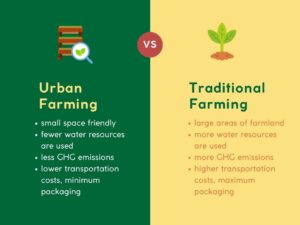
9. Future Trends in Urban Agriculture
As technology evolves, the integration of vertical and traditional farming is expected to form hybrid systems that combine the strengths of both. Key trends shaping the future include:
- Development of hybrid models combining rooftop gardens with peri-urban farms.
- AI-driven systems for autonomous cultivation and harvesting.
- Integration with renewable microgrids to power indoor farms sustainably.
- Public-private partnerships promoting urban agriculture policies.
- Community-based models enhancing local food sovereignty.
Experts from the World Resources Institute (WRI) predict that urban agriculture could meet up to 20% of global fruit and vegetable demand by 2050 if integrated with sustainable city planning.
Conclusion
The comparison between vertical and traditional farming to ensure urban food security reveals that both systems play indispensable yet distinct roles in feeding a rapidly urbanizing world. Traditional farming remains essential for large-scale staple crop production, while vertical farming provides a sustainable, high-tech solution for local fresh produce in cities.
Rather than competing, these models can coexist synergistically. The integration of vertical farming into urban planning, supported by renewable energy and AI, offers a path toward resilient, low-emission, and equitable food systems.
Ensuring food security in the 21st century will require innovation, collaboration, and the willingness to rethink how and where food is produced. By combining traditional wisdom with modern technology, humanity can secure a sustainable and nutritious food future for urban populations worldwide.
Data Management in the Dairy Industry: What to Measure and Why
Wearable Technologies Applied to Livestock Management

Vertical Farm Systems: Sustainable Indoor Agriculture

Comparative Evaluation of Climate Change-Resistant Wheat Varieties in Eastern Europe

Integrating IoT Sensors into Grain Crops: Towards Agriculture
Precision Agriculture and Variable Corn Seeding Rates: The Smart Way to Farm
You might like...