
5 min read
Table
- What winter wheat and spring wheat mean
- Sowing and harvest calendar by region
- Where each type dominates in Russia
- Yields, protein and end use: spring vs winter wheat yields Russia
- Russia’s 2025/26 wheat numbers in context
- Where to check current data and official records
- Frequently Asked Questions
- Sources
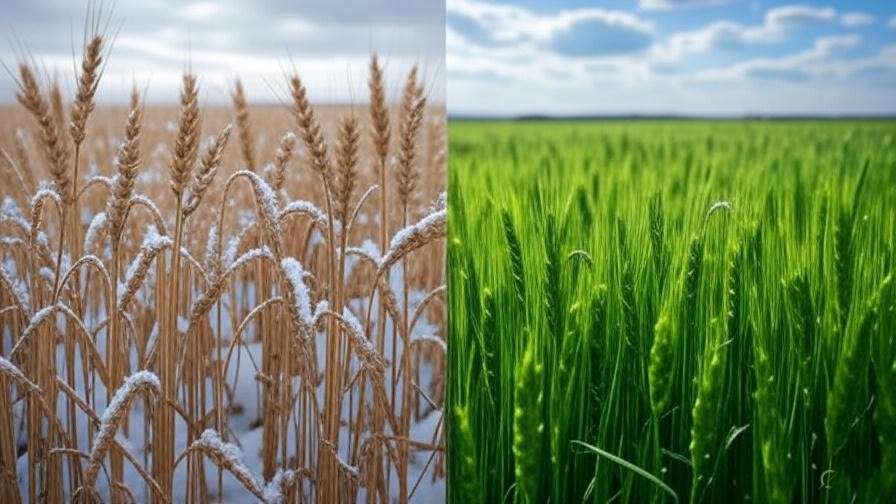
Winter wheat is sown in late summer and autumn, survives winter as a young plant, and is harvested in summer. Spring wheat is sown after the soil thaws and harvested later in the season. In Russia, winter wheat dominates the warmer south, while spring wheat leads in the colder Volga, Urals and Siberia.
What winter wheat and spring wheat mean
Winter wheat requires a cold period, or vernalization, before it shifts from vegetative growth to stem elongation and heading. It is planted in autumn, develops roots and tillers before dormancy, and resumes growth when temperatures rise. Spring wheat skips that chilling requirement; it is planted after thaw, grows through one season, and matures before autumn. Vernalization is not just exposure to cold weather; it is a biological requirement that prevents winter wheat from heading before it has enough leaf area to support grain. The autumn-rooted plant also starts spring with a developed root system, which can capture soil moisture earlier than a newly sown spring crop. In Russia the distinction appears in official variety descriptions: winter and spring types are registered separately in the State Register of Selection Achievements Admitted for Use (Государственный реестр селекционных достижений). Soil moisture and snow cover shape winter survival, the same resource base covered in the site’s sustainable soil management guide.
Sowing and harvest calendar by region
Concrete sowing windows distinguish the two wheats in Russia; the key range for Russia winter wheat sowing dates runs from late August through October in the south. FAO GIEWS reported that spring sowing for 2026 had started by late March. Timing matters because a winter wheat plant has to accumulate enough reserves to survive ice, snow mold and alternating thaw-freeze cycles, while a late-sown field enters dormancy weak. In the south, many growers target the last week of August through the first half of October; official recommendations vary by variety and local conditions. Spring wheat areas work with a shorter season: once soil can be worked, sowing is often completed in as few days as possible to use available moisture.
| Type | Vernalization | Typical sowing in Russia | Harvest | Primary zones |
| Winter wheat | Required | Late August–October in the south | Summer | Southern Federal District, North Caucasus |
| Spring wheat | Not required | Late March onward in the south; after thaw in the east | Late summer | Volga, Urals, Siberia |
The southern sowing window matters for national production because the largest share of Russian winter wheat is planted there before dormancy.
Where each type dominates in Russia
Winter wheat dominates the warmer south because autumn planting lets it use winter moisture and mature before summer heat stress. Spring wheat dominates colder eastern regions—Volga, Urals and Siberia—where winter kill makes autumn-sown wheat unreliable. The split has shifted with weather and economics but has not reversed: Russia still produces a large spring crop by world standards, and few other major exporters grow as much spring wheat. That split also affects seed systems and breeding targets, because a winter wheat variety admitted for the North Caucasus is not automatically useful in Siberia. The Southern Federal District and North Caucasus grow most winter wheat; the Volga, Urals and Siberia grow most spring wheat. Climate-resilient varieties matter in both zones, especially in the east, where short seasons and cold winters narrow the choices; the site’s climate-resilient varieties overview explains selection criteria.
Yields, protein and end use: spring vs winter wheat yields Russia
The spring vs winter wheat yields Russia pattern depends on location. Winter wheat generally produces higher yields where water and milder winters allow; spring wheat is the safer choice in colder eastern regions. Protein is the other half. For spring wheat protein content in Russia, hard spring wheat tends to carry more protein and gluten strength than soft winter wheat; Russian spring wheat is therefore used in strong flour and export blending, while winter wheat adds volume in feed and milling. The protein difference is not absolute; environment, variety and fertilization matter. Russian spring wheat grown in dry continental areas often forms harder kernels, while winter wheat from high-yield southern fields tends toward softer grain. Buyers use this to blend a base wheat with a strong wheat, and Russian spring wheat frequently fills the strong side. The site’s cereal crop yields comparison puts that wheat, barley and corn trade-off in context.
| Trait | Winter wheat in Russia | Spring wheat in Russia |
| Yield | Higher in the south | Lower in dry or short-season zones; competitive in favorable eastern areas |
| Protein | Usually lower | Often higher, stronger gluten |
| End use | Feed, milling, volume export | Strong flour, blending, export |
Russia’s 2025/26 wheat numbers in context
The FAO GIEWS country brief for the Russian Federation reports 2025 wheat production around 91.1 million t and notes that the 2026 winter crop area was below average. Winter crop area below average does not mean a small crop, but it signals that sowing conditions or profitability have shifted. Export logistics follow the same geography: winter wheat from the south moves through Black Sea ports, while spring wheat from the Urals and Siberia often travels by rail to domestic mills or export terminals. Changes in export duties or domestic milling demand can shift the incentive toward one type or the other. The site’s wheat production in 2025 and Russia’s grain exports pieces add economic context.
Where to check current data and official records
For updated production numbers, the FAO GIEWS country brief is a stable starting point; Rosstat is Russia’s official statistics service; the State Register of Selection Achievements Admitted for Use lists winter and spring varieties by region of admission. Consulting the State Register helps a buyer see whether a variety is winter or spring, its region of admission, and its end-use class. Rosstat publishes regional planted area and production; the FAO brief adds global crop monitoring.
Frequently Asked Questions
What is the difference between winter wheat and spring wheat?
Winter wheat is planted in autumn and vernalizes; spring wheat is planted after thaw and completes its cycle in one season.
When is winter wheat planted in Russia?
In the south roughly late August to October, before winter dormancy.
Where is spring wheat grown in Russia?
Mostly in the Volga, Urals and Siberia, where winters are too severe for reliable winter survival.
Which yields more, winter or spring wheat?
Winter wheat generally yields more where water and milder winters allow; spring wheat wins in colder eastern regions.
Is Russian spring wheat higher in protein?
Often yes: hard spring wheat tends to carry more protein and gluten strength, used in strong flour and export blending.
Sources
FAO GIEWS Country Brief on Russian Federation Rosstat, official Russian statistics service State Register of Selection Achievements Admitted for Use
Russian Grain Storage Capacity: Guide and Sources
Russian State Register of Selection Achievements: What It Is and How to Use It

Integrated Pest Management with a Preventive, Not Reactive, Approach

Wheat Crop Management: A Complete Guide to Sustainable Production and Higher Yields

Reclaiming Soviet-era Farmland: Cases of Successful Conversion to Modern Crops

The Role of AI-Powered Drones in the Early Detection of Pests in Extensive Crops
You might like...